Tutorials
Build a Three-Role Agent Pipeline in Python with CrewAI
Build a three-role AI hackathon pipeline in Python with CrewAI and a small Claude model, with capped calls and telemetry turned off.
By Starfield LabsPublished Intermediate30 min

Before you start
- Python 3.10 to 3.13 (CrewAI does not support 3.14 at the time of writing)
- About 1 GB of free disk space
- An Anthropic API key
You build a Python script in which three agents hand work to each other. A researcher lists facts, a writer turns them into a short note, and a reviewer checks the note against the facts. It uses the CrewAI library and the small claude-haiku-5-5 model.
Time: about 30 minutes, plus a large install. Level: intermediate. You need: Python 3.10 to 3.13 (CrewAI does not support 3.14 at the time of writing), about 1 GB of free disk space, and an Anthropic API key. Tested: 12 November 2026 with Python 3.11.15, crewai 1.15.40 and anthropic 0.73.0 on macOS.
Model replies differ from run to run. The wording and the token counts you see will not match the output below. The shape of the output will.
A team that splits a task into roles can fit a demo into an AI hackathon weekend, and each role is easy to test on its own. If you are planning a project, see the upcoming AI hackathons.
Why this matters
One long prompt asking a model to research, write and check its own work mixes three jobs. Splitting them gives each step one narrow instruction, and the next step receives the earlier output as input. A reviewer that is a separate step can also say no. A framework such as CrewAI handles the hand-off, but it adds weight. This tutorial measures that weight: the install size, the number of requests and the tokens used.
See it running first
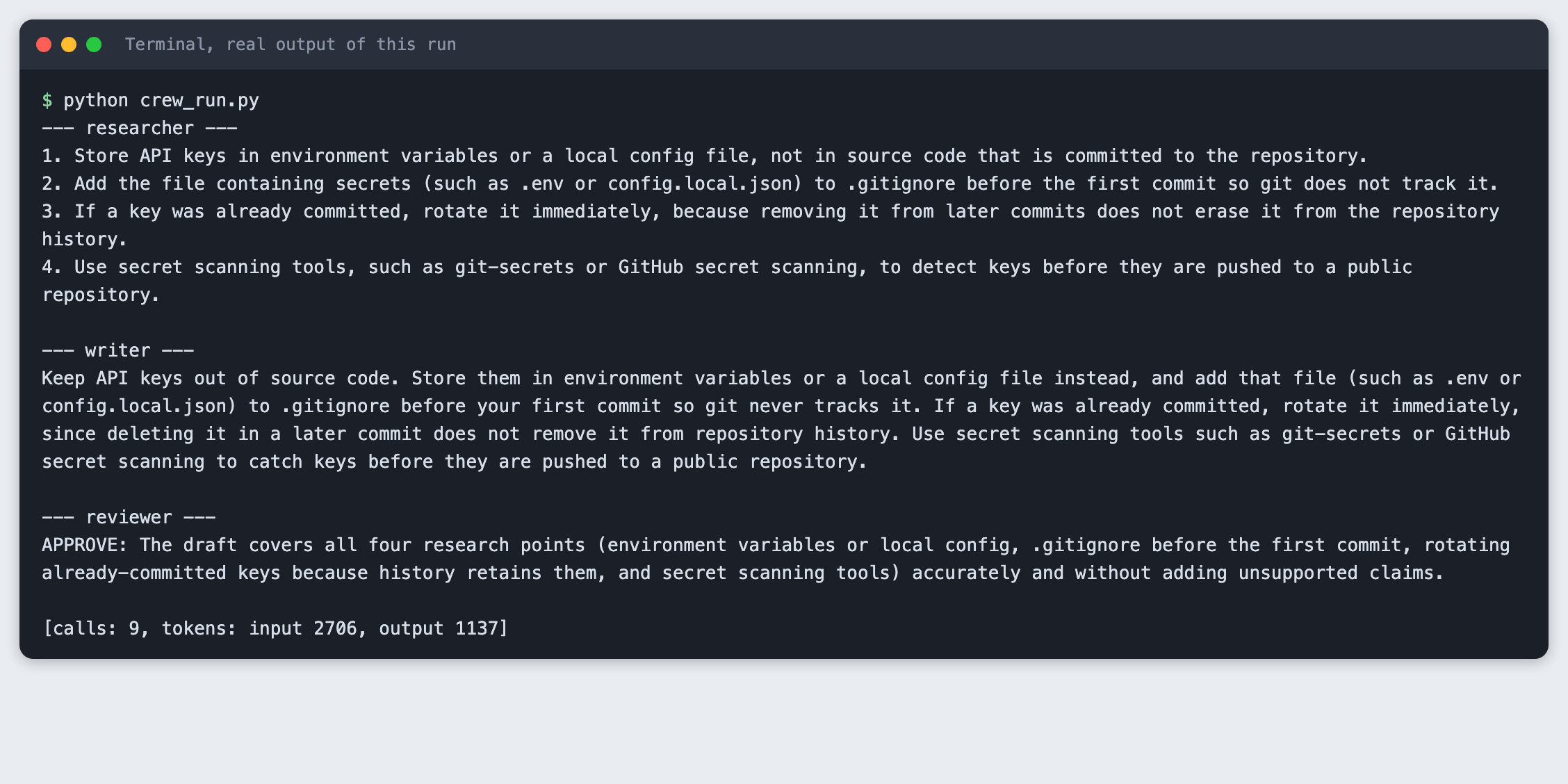
This is the finished crew on a small topic: keeping an API key out of a public git repository. The three outputs come from three agents, and the last line is CrewAI's own count of requests and tokens.
The rest builds it from nothing.
Step 1: Check the licence, the size and the Python version
Before you install a framework, look at what you are taking on.
- Licence. The PyPI page for
crewaihas no licence field. The project's GitHub repository carries an MIT licence file. Read it yourself before you use the library in a product. - Python version. The package declares support for Python 3.10 up to, but not including, 3.14. On Python 3.14,
pipfound no matching version when this tutorial was built. So the tutorial uses Python 3.11. - Size. CrewAI pulls in a vector database client, a PDF reader and a telemetry stack, among others. Step 2 shows the real size.
Step 2: Set up the project
Create a virtual environment with a supported Python version:
python3.11 -m venv .venv
Put the requirement in requirements.txt. The anthropic extra matters. Without it, CrewAI raised an ImportError saying the native Anthropic provider was not available, when this tutorial was built.
crewai[anthropic]>=1.15.40
File: requirements.txt
Install it. This takes several minutes:
pip install -r requirements.txt
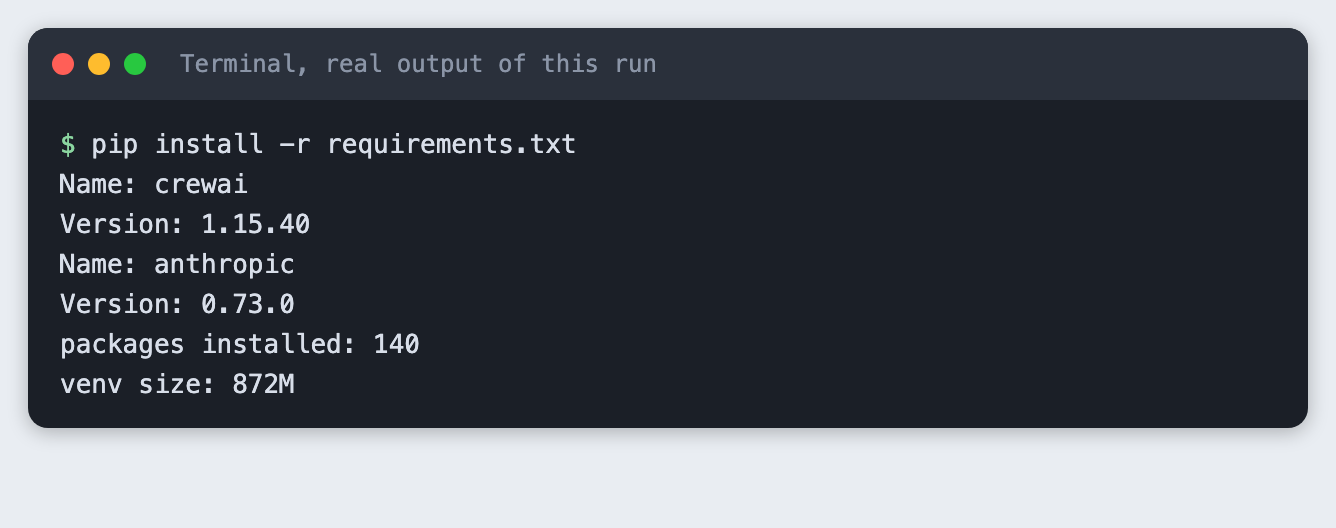
The virtual environment holds 140 packages and takes 872M on disk. That is a lot for three API calls, and it is the main cost of using a framework here. The download size was not measured separately.
Put your key in a file named .env, copied from the placeholder file:
ANTHROPIC_API_KEY=your_key_here
File: .env.example
Never paste a real key into code, a screenshot or a chat. Load it into your terminal on macOS or Linux:
set -a; source .env; set +a
Step 3: Switch telemetry off
CrewAI can send usage data to its maintainers. This tutorial turns that off before the library is imported. The script sets three environment variables: CREWAI_DISABLE_TELEMETRY, CREWAI_DISABLE_TRACKING and OTEL_SDK_DISABLED. A short script confirms the setting by asking the library itself:
"""Show that CrewAI telemetry is switched off by the environment settings."""
import os

os.environ.setdefault("CREWAI_DISABLE_TELEMETRY", "true")
os.environ.setdefault("CREWAI_DISABLE_TRACKING", "true")
os.environ.setdefault("OTEL_SDK_DISABLED", "true")

from crewai.telemetry.telemetry import Telemetry

for name in ("CREWAI_DISABLE_TELEMETRY", "CREWAI_DISABLE_TRACKING", "OTEL_SDK_DISABLED"):
    print(f"{name}={os.environ[name]}")
print("telemetry disabled:", Telemetry._is_telemetry_disabled())
File: telemetry_check.py
python telemetry_check.py
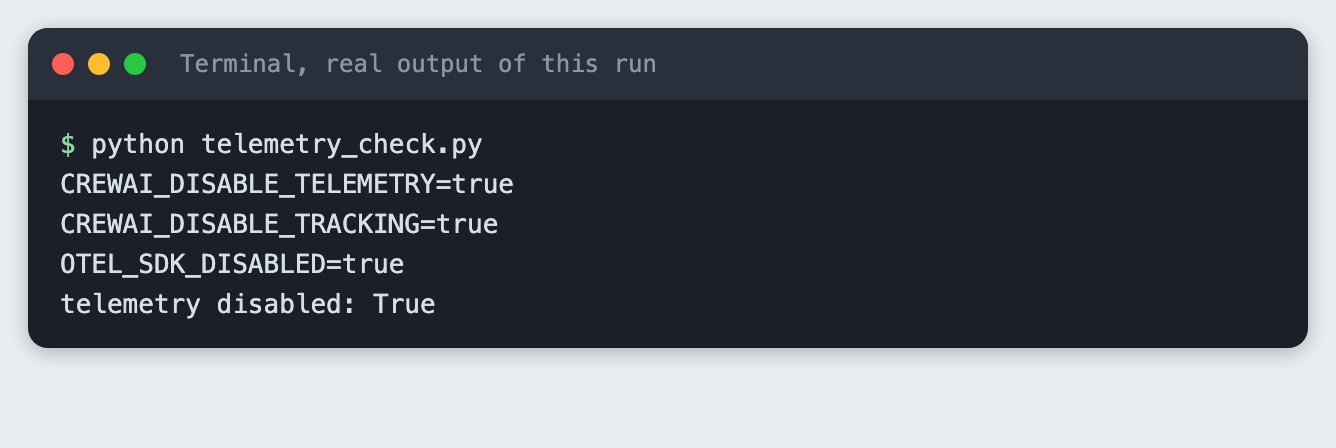
This checks the library's own switch. It does not prove that no network traffic leaves your machine, and this tutorial did not inspect traffic.
Step 4: Write the crew
Each agent has a role, a goal, a short backstory and the same model. Delegation is off, and max_iter is 2, so an agent cannot start a long loop. max_tokens is 500 for each model reply. These are the hard caps on cost.
Each task names its agent. context passes earlier outputs to a later task: the writer sees the research, and the reviewer sees both the research and the draft. The process is sequential, so the tasks run in the order they are listed.
"""Three-role pipeline with CrewAI: researcher -> writer -> reviewer."""
import os
import sys

# Check the key first. CrewAI reads a .env file on import, so checking afterwards
# would hide a key that is missing from your shell.
if not os.environ.get("ANTHROPIC_API_KEY"):
    sys.exit("ANTHROPIC_API_KEY is not set. Export it or load your .env first.")

# Opt out of telemetry before crewai is imported.
os.environ.setdefault("CREWAI_DISABLE_TELEMETRY", "true")
os.environ.setdefault("CREWAI_DISABLE_TRACKING", "true")
os.environ.setdefault("OTEL_SDK_DISABLED", "true")

from crewai import Agent, Crew, LLM, Process, Task

TOPIC = "keeping an API key out of a public git repository"

llm = LLM(model="anthropic/claude-haiku-5-5", max_tokens=500)


def agent(role, goal):
    return Agent(role=role, goal=goal, backstory=f"You are the {role} on a small team.",
                 llm=llm, allow_delegation=False, max_iter=2, verbose=False)


researcher = agent("researcher", "List accurate points about a topic")
writer = agent("writer", "Turn research notes into a short, clear note")
reviewer = agent("reviewer", "Check a draft against the research notes")

research = Task(description=f"List 4 short factual points about {TOPIC}. One line each.",
                expected_output="A numbered list of 4 lines.", agent=researcher)
draft = Task(description="Write a note of at most 80 words from the research points.",
             expected_output="One paragraph, at most 80 words.", agent=writer, context=[research])
review = Task(description="Compare the draft with the research points. Start with APPROVE or REVISE, "
              "then give one sentence of reasons.",
              expected_output="APPROVE or REVISE, then one sentence.", agent=reviewer,
              context=[research, draft])

crew = Crew(agents=[researcher, writer, reviewer], tasks=[research, draft, review],
            process=Process.sequential, verbose=False)
result = crew.kickoff()

for name, task in (("researcher", research), ("writer", draft), ("reviewer", review)):
    print(f"--- {name} ---\n{task.output.raw}\n")
usage = result.token_usage
print(f"[calls: {usage.successful_requests}, tokens: input {usage.prompt_tokens}, output {usage.completion_tokens}]")
File: crew_run.py
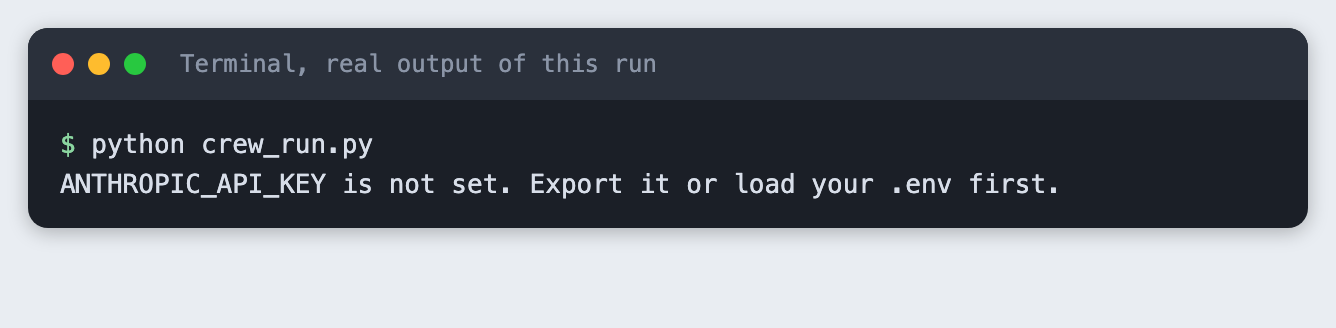
The key check sits at the top, before the import of crewai. The reason: CrewAI loads a .env file when it is imported. When this tutorial first checked the key after the import, the script found a key in a parent folder's .env and made 9 real requests in a step that was meant to show a missing key.
First see what a missing key looks like. Run the script in a terminal where the variable is not set:
python crew_run.py
Step 5: Run it
With the key loaded:
python crew_run.py
--- researcher ---
1. Store API keys in environment variables or a local config file, not in source code that is committed to the repository.
2. Add the file containing secrets (such as .env or config.local.json) to .gitignore before the first commit so git does not track it.
3. If a key was already committed, rotate it immediately, because removing it from later commits does not erase it from the repository history.
4. Use secret scanning tools, such as git-secrets or GitHub secret scanning, to detect keys before they are pushed to a public repository.

--- writer ---
Keep API keys out of source code. Store them in environment variables or a local config file instead, and add that file (such as .env or config.local.json) to .gitignore before your first commit so git never tracks it. If a key was already committed, rotate it immediately, since deleting it in a later commit does not remove it from repository history. Use secret scanning tools such as git-secrets or GitHub secret scanning to catch keys before they are pushed to a public repository.

--- reviewer ---
APPROVE: The draft covers all four research points (environment variables or local config, .gitignore before the first commit, rotating already-committed keys because history retains them, and secret scanning tools) accurately and without adding unsupported claims.

[calls: 9, tokens: input 2706, output 1137]
The researcher produced four points, the writer joined them into one note, and the reviewer replied APPROVE with a reason. The final line reports 9 requests, 2706 input tokens and 1137 output tokens. Those figures come from CrewAI's usage counter.
There are three tasks, and the counter says 9 requests. This tutorial did not find out why. The counter may include more than one request per task, but that was not verified against the API's own logs. Treat the figure as an upper bound on cost and watch it when you change the crew.
The reviewer in this run approved the draft. Nothing here shows that the reviewer would catch a wrong claim, because the draft matched the research. To test that, change a task so the writer is asked to add a fact that is not in the research, then see whether the reviewer replies REVISE.
Troubleshooting
ImportError: Anthropic native provider not available. Install with the extra:pip install "crewai[anthropic]". This happened here with a plaincrewaiinstall.pipfinds no matching version ofcrewai. Checkpython --version. On Python 3.14 the install failed here. Use 3.10 to 3.13.- The missing-key check passes even though the key is not exported. CrewAI reads
.envfiles on import, from the current folder and its parents. Check the key before the import, ascrew_run.pydoes. - The reviewer's reply stops in the middle of a word. This happened in one run with
max_tokensat 300. The reply was cut by the limit. Raising it to 500 fixed that in the runs that followed. The cause was not investigated further. - The install is slow. It is 872M. A second install on the same machine may reuse
pip's cache.
Frequently asked questions
Does CrewAI work with a small Claude model?
Yes, in this tutorial. With the model name anthropic/claude-haiku-5-5 and the anthropic extra installed, the three-role crew ran and finished with no errors. The one failure seen was a reply cut by a 300-token limit, which a limit of 500 avoided.
How do I switch CrewAI telemetry off?
Set CREWAI_DISABLE_TELEMETRY, CREWAI_DISABLE_TRACKING and OTEL_SDK_DISABLED to true before you import the library. telemetry_check.py shows the library then reports telemetry as disabled. It does not inspect network traffic.
How many API calls does a three-agent crew make?
CrewAI reported 9 requests for 3 tasks in this run, 2706 input tokens and 1137 output tokens. The reason for 9 was not checked. Caps in the code (max_iter, max_tokens, no delegation) bound the cost of each agent.
What to try next
- Give the writer an instruction to add one fact that is not in the research, and check that the reviewer says REVISE.
- Send a REVISE verdict back to the writer for one more draft, and cap it at one retry.
- Build the same three hand-offs with plain SDK calls and compare the request count and the install size.
How this tutorial was tested
- Date: 12 November 2026. Python 3.11.15,
crewai1.15.40,anthropic0.73.0, macOS. The model isclaude-haiku-5-5. - The code in this article is copied from the project files by a script. The output and screenshots come from saved logs of real API calls.
- Every step was run from a clean folder, then replayed from an empty copy of the folder with a new virtual environment. The replay passed. The model's wording differed, and the replay reported 9 requests, 2883 input tokens and 1899 output tokens, where the numbers above come from the saved evidence run.
- Terminal screenshots are rendered from the saved output of the run. They are not captures of a terminal window.
- Not run: Windows, Linux, Python 3.10, 3.12 and 3.13, other models, a plain-SDK version of the crew (CrewAI worked, so the fallback was not needed), and a check of network traffic with telemetry off.